Menu
Capittal Research
M&A, valuation and corporate tax insights.
Practical guides, sector analysis and criteria for preparing company acquisitions, sales and valuations.
Published archive
59
Editorial archive connected to sectors, categories and SEO-ready URLs.
Latest articles
Archive and latest publications.
59 results.

Capittal opina
Capittal's view: I have two offers for my company, how do I know which is better?
The headline price is not comparable between two offers: the only comparable figure is the net cash you receive on completion day, once net debt, the working capital adjustment, escrow, earn-out, fees and tax have been deducted. The conditional portion is valued separately, multiplied by its probability of payment and discounted for the time and the stay-on it demands.

Capittal opina
Capittal's view: share deal or asset deal, which suits the seller?
The seller wants to sell shares and the buyer wants to buy assets, because that choice decides who keeps the tax, employment and contractual history of the company. The argument is not settled by changing the paperwork, but with price and with warranties.

Capittal opina
Capittal's view: sell to a third party or hand the company over to my children?
This decision is not settled by sentiment but on four axes: a real successor, tax, liquidity and concentration risk. The costliest mistake is deciding by default, without valuing the company first.

Capittal opina
Capittal's view: can I sell my company with a tax audit or litigation open?
You can sell a company with a tax audit or litigation open: buyers reject unknown risk, not quantified risk. The contingency is measured in three layers and absorbed through escrow, indemnity, price adjustment or insurance.

Capittal opina
Capittal's view: what you sign with an M&A adviser, exclusivity, tail and exit
The mandate letter decides how much your adviser is paid, for how long and on what amount. The clauses that move money are the success fee base, exclusivity, the tail and the carve-outs.

Capittal opina
Capittal's view: I have sold my company, what do I do with the money?
The decision about the sale proceeds is not taken after closing, it is taken before: the structure you sell through fixes whether the price lands in your personal account or in a holding company's. The expensive mistake is not picking the wrong investment, it is having been paid through the wrong vehicle.

Capittal opina
Capittal's view: when I sell, do my contracts, lease and bank facilities survive?
A share sale keeps the same company as the contracting party, so most contracts survive unless a change-of-control clause says otherwise. The ones that do carry such a clause (key customers, banks, landlords, licences) should be reviewed before going to market, not during due diligence.

Capittal opina
Capittal's view: a company valuation is not the sale price
A valuation sets a reasonable range for negotiating; the market sets the price and the equity bridge sets what the seller actually banks. How enterprise value, sale price and certain money differ.

Capittal opina
Capittal's view: when to sell a company and when to wait
The best moment to sell is not set by the owner's tiredness or by the macroeconomic headline, but by what the business can prove: a sustained EBITDA track record, reduced dependence on the owner and a management team that runs the company without them. When your own timing and the market's do not coincide, preparation is what decides.

Capittal opina
Capittal's view: the buyer cuts the price after due diligence, what can you do?
A price cut after due diligence is only legitimate when there is a documented finding, quantified in euros and affecting future earnings. Anything else is tactics, and it is answered with a trade or by walking away.
Capittal opina
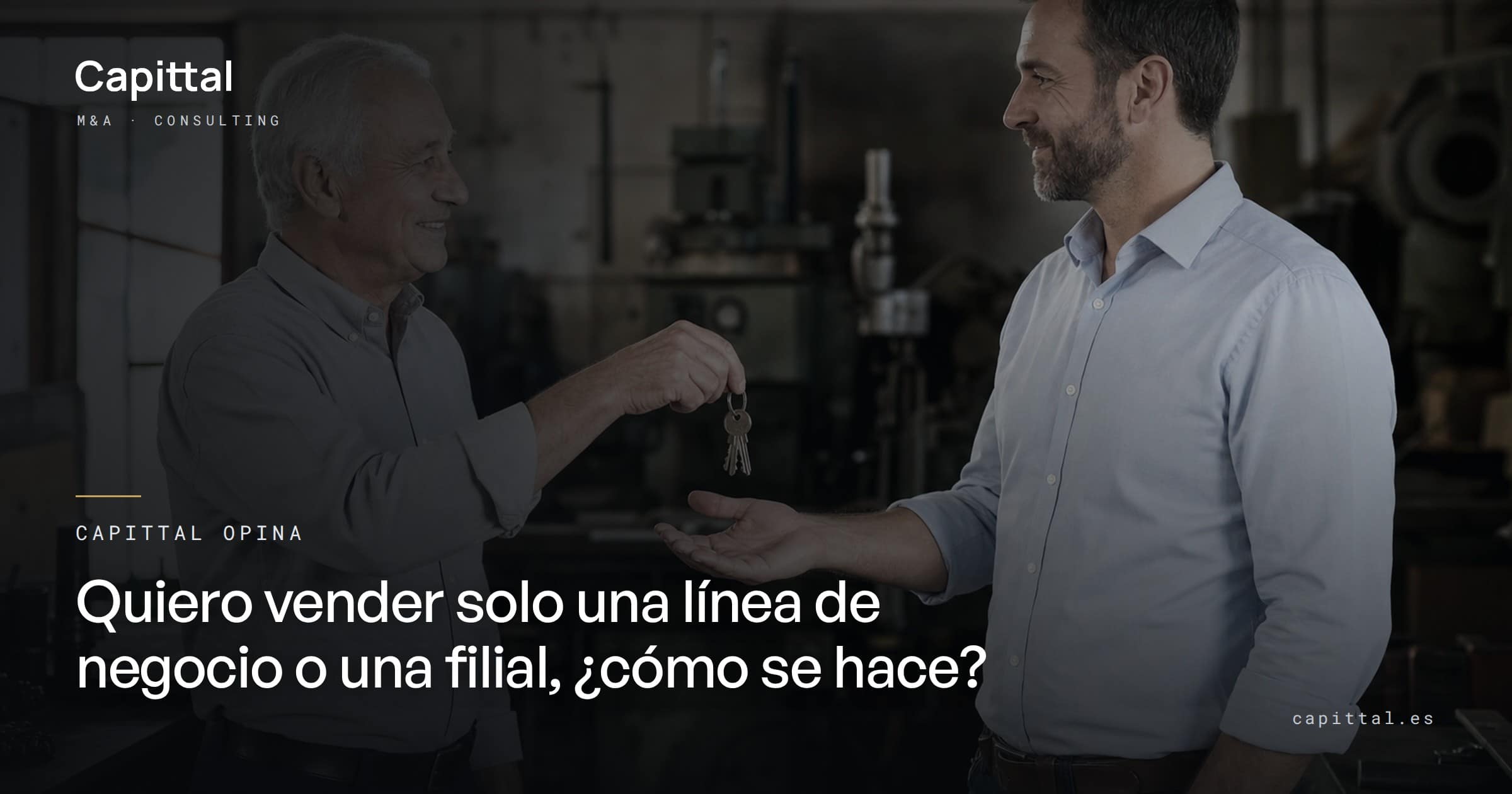
Capittal's view: I want to sell just one business line or subsidiary, how does it work?
Selling a business line or a subsidiary requires genuinely separating it before you sell it, not just signing a deed. Price is decided by the line's standalone EBITDA and by the costs left stranded in the parent.

Tax
Taxes on Selling a Company in Spain [2026]: Seller Guide
A practical guide to Spanish tax on a company sale: resident individuals, corporate sellers, share versus asset deals, deferred price and non-residents.